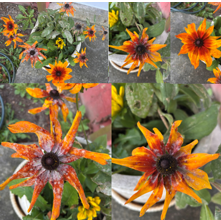

Hello, fellow pilgrims. The other day, a stand of Black-Eyed Susans caught my eye. They stood there so poetically in their state of transition and beauty that I had to take a picture (or several). I was struck by how resilient and beautiful the flowers looked in the midst of an unpredictable and wildly-swinging climate. One day it is 40 degrees Fahrenheit, the next day it is 80 degrees Fahrenheit. And some days it fluctuates from 32 degrees in the morning to 78 degrees in the evening. How is anything supposed to cope with a climate like that? Then it occurred to me that the desert is very much like that, and so much of the beauty in a desert lay unnoticed by many because of the outstanding harshness of its elements. But the beauty is there; not struggling against the harshness, but poetically emanating its beauty in the midst of its challenging climate. In fact, I would argue that its beauty is in direct response to its challenging environment. Have you ever seen a cactus bloom? Or witnessed a desert “super bloom”? There are no words to adequately describe that beauty, that resilience, that miraculous witness to God’s power and might and LOVE. Those Black-Eyed Susans (Rudbeckia hirta) stood there poetically displaying their resilience and wisdom—transitioning from young, vibrant long-stemmed reminders of the beauty and wonder of creation to long-stemmed reminders of resilience, wisdom, and strength—all the more beautiful for its journey. They are like bouquets from God, reminding us that we are beautiful and beloved and strong and resilient.
The Black-Eyed Susan carries meaningful spiritual symbolism, as well. It can thrive in a variety of landscapes and climates with little maintenance. It can withstand harsh conditions that many other flowers cannot. Its petals emanate outwardly like sunshine encouraging the whole plant to persevere. And as it ages, its wisdom shows. Its petals tilt downward as it pushes forward its seed cone, preparing the world for its next generation while feeding its siblings in nature, before it takes its long winter’s rest. A soulful cycle of spiritual ecology—growth, rest, renewal—through which we might become intimately aware of our interconnectedness with all of Creation and the kinship of our needs.
We receive flowers from God every day, whether we notice and acknowledge them or not. Tattered as they may appear as they fade into winter, they are resilient and strong, and they are preparing for rest and renewal. Biologist and sustainability advocate, Graham Pyke (Macquarie University), says it best. Wilting flowers are not dying. They are storing potential.
What can we learn from the resilience of the Black-Eyed Susan? From other flowers as they grow, rest, and renew?
Sometimes the challenges of life might leave us feeling (and perhaps looking) a bit wilted and run-through. How can we use those challenges as opportunities to grow, rest, and renew?
Yes. These flowers are poetic. And so are you. Let your resilience shine like a beacon. Let your experiences help you grow. And don’t forget to rest. It is a vital component of our sustenance and renewal.
You are Beautiful and you are Beloved.
Angela+