
頑張って
Ganbatte! Persevere!
Hello, fellow pilgrims. Each week, through scripture, we witness people struggling—with their faith, with their lives, with one another. And we are invited to consider our own struggles. What might we learn from our brothers and sisters in scripture? How might we apply that learning to our own lives, our own struggles? What are we to do?
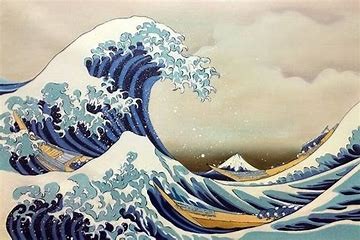
Last week in worship and in Bible study, we spoke of BE-attitudes, guidelines of encouragement that can help us stay focused on Christ-centered faith and love—and how blessed we are to do so. This week’s lectionary readings have me reflecting upon ways we might stay encouraged through all of the challenges that this being human can entail. And, of course, as you know I am wont to do, my reflection involves art and no small amount of philosophy and symbolism. I reflected upon a Japanese philosophy called Ganbatte (gahn-BAHT-tay). Ganbatte is best represented in one of Hokusai’s famous block prints featuring Mt. Fuji—The Great Wave off Kanagawa. I’ve spent a lot of time gazing upon this famous print because it is one of my favorite works of art. It carries such depth of meaning. For me, the great wave represents the challenges we experience in our lives as they relentlessly push us forward—wave after wave, challenge after challenge—as the undertow of uncertainty threatens to pull us back. And we are the subjects of this masterpiece, rowing our way through the sometimes-overwhelming barrage of life’s challenges. In my Christian interpretation, Mt. Fuji represents God—a strong and steadfast presence—reminding us that while waves of difficulty may feel overwhelming and insurmountable, God will see us through. God is the constant—the omnipresent force of encouragement. Our faith in God keeps us moving forward, even when our challenges feel larger than Mt. Fuji—larger than God Godself. Of course, nothing is larger than God, but our human psyches might convince us otherwise when we feel like we are drowning in waves of uncertainty, and we begin to lose hold of our faith.
If you look closely at the print, you might notice that one of the waves (the one crashing overtop the boat in the forefront, stage right) is shaped like Mt. Fuji! Have you ever felt like a wave the size of a mountain has crashed into you—a wave of grief or fear or stress? Have you ever struggled to get your head back above the waterline, only for another wave to then crash into you? Look closely once more and you might also notice that there are three boats, each filled with fishermen. These boats were used to carry fish to markets and, much like in Biblical times, it took teamwork to catch and to transport the fish. This points to the importance of community. Alone, we might succumb to the waves of life’s challenges, but together and with God, we can withstand them.
The Japanese philosophy of Ganbatte is one of faith, hope, and resilience. If we hold onto our faith—if we look toward the horizon and know that God remains with us, steady and true—we can withstand any wave of challenge that life pushes our way. And we can do so especially in community.
The spirit of Ganbatte is that it is a mindful practice that centers us on the present moment—on the here and now—and our persevering faith. It emphasizes a deep connection with the Divine and buoys us as we persevere through life’s challenges knowing that our God is steadfast and true. It acknowledges Divine grace and presence in our lives (as Joshua points out in this week’s reading from the Old Testament) and offers us space to lean into it deeply, faithfully and courageously. It is the essence of Trust.
And that is what our readings this week speak to us. To know that we are not alone; to hold fast to and trust in our faith; and to persevere—together, in community.
Here we are, God, ever mindful of Your Presence.
Ganbatte!
You are Beautiful and you are Beloved.
Angela+